


The Echeveria Care Guide: Tips for Thriving Rosettes
- Dec 15, 2025
- 3 min read
1. Introduction: The Charm of Echeverias
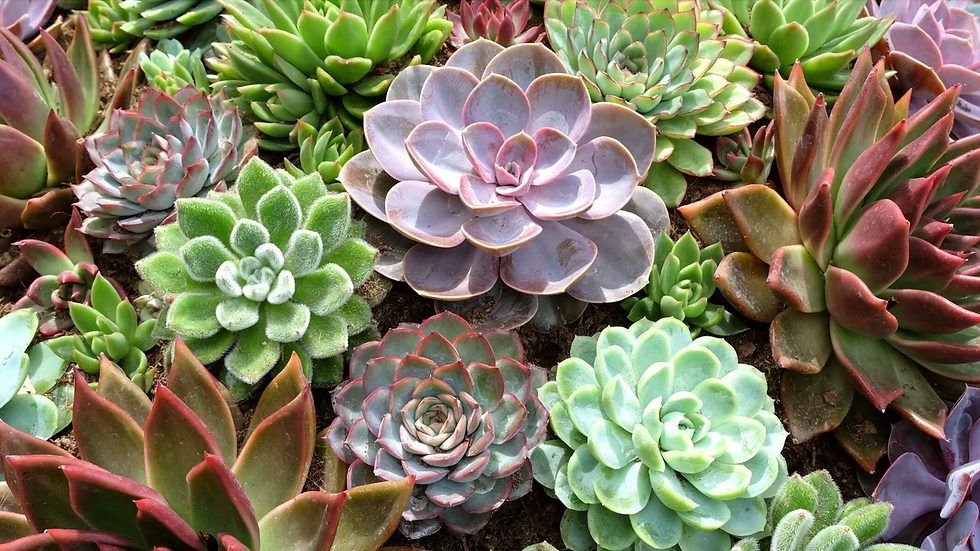
Echeverias are perhaps the most popular and recognizable group within the succulent family. Beloved for their beautiful, symmetrical rosette shapes, diverse colors, and fuzzy or waxy textures, they make fantastic houseplants and garden additions. While relatively easy to care for, Echeverias thrive only when their specific needs for light and water are met.

2. Light Requirements: The Key to Color and Compactness
Echeverias demand ample light to maintain their tight, attractive rosette shape and vibrant colors.
Ideal Light: They require a minimum of 6 hours of bright light per day. A south-facing window is usually best for indoor growing.
Outdoor: If grown outdoors, they thrive in full sun, though some varieties may appreciate a little afternoon shade during extreme summer heat.
Signs of Insufficient Light (Etiolation): If your Echeveria is not getting enough light, it will start to stretch upwards, losing its compact shape. This is called etiolation, and the stems will look sparse and pale as they search for light.
3. Watering: The 'Soak and Dry' Method
Overwatering is the number one killer of Echeverias. They are designed to store water in their thick leaves and are highly susceptible to root rot if left in consistently moist soil.
The Rule: Always use the "soak and dry" method. Wait until the soil is completely dry before watering again.
How to Check: Stick your finger about an inch or two into the soil, or use a moisture meter. If it feels dry, you can water.
Method: Water thoroughly until it drains out of the pot's drainage hole. Never let the pot sit in standing water.
Seasonal Adjustment: Water less frequently during the cooler, darker winter months when the plant enters dormancy.

4. Soil and Potting Essentials
The right medium and container are crucial for ensuring proper drainage.
Soil: Use a well-draining succulent or cactus mix. You can enhance drainage by adding perlite, pumice, or coarse sand (up to 50% mix) to standard potting soil.
Pot: Always use a pot with a drainage hole. Terracotta pots are often recommended because the porous material helps wick away excess moisture from the soil.
Repotting: Repot every 1–2 years, or when the plant outgrows its container. Choose a pot that is only slightly larger than the root ball.

5. Temperature and Humidity
Echeverias prefer warm, arid conditions.
Temperature: They thrive in temperatures between $65^\circ \text{F}$ and $75^\circ \text{F}$ ($18^\circ \text{C}$ and $24^\circ \text{C}$).
Frost Warning: Most Echeveria varieties are not frost-tolerant. If temperatures drop below $40^\circ \text{F}$ ($4^\circ \text{C}$), bring them indoors or provide protection.
Humidity: They tolerate normal household humidity but are sensitive to very high humidity, which can contribute to fungal issues.

6. Dealing with Pests and Common Problems
While generally robust, keep an eye out for these issues:
Mealybugs: These fuzzy, white pests often hide in the crevices of the rosette. Treat them by dabbing them directly with a cotton swab soaked in rubbing alcohol.
Rot: The most common issue, usually caused by overwatering. If the base of the plant is black or mushy, you may need to take healthy cuttings to propagate and save the plant.

7. Propagation (Making More Rosettes)
Echeverias are easy to multiply using three main methods:
Leaf Cuttings: Gently twist a healthy leaf off the stem. Let it callous for a few days, then lay it on top of dry soil until new roots and a baby rosette form.
Offsets (Pups): Many varieties produce small "pups" or offsets at the base. Gently remove these and pot them separately once they are large enough.
Beheading: For etiolated plants, cut off the top rosette, let the stem callous, and replant the rosette in fresh soil. The old stem will often produce new offsets.

By following these guidelines—especially by being strict about watering and generous with light—your Echeveria rosettes will stay compact, colorful, and stunning for years to come.


Comments